

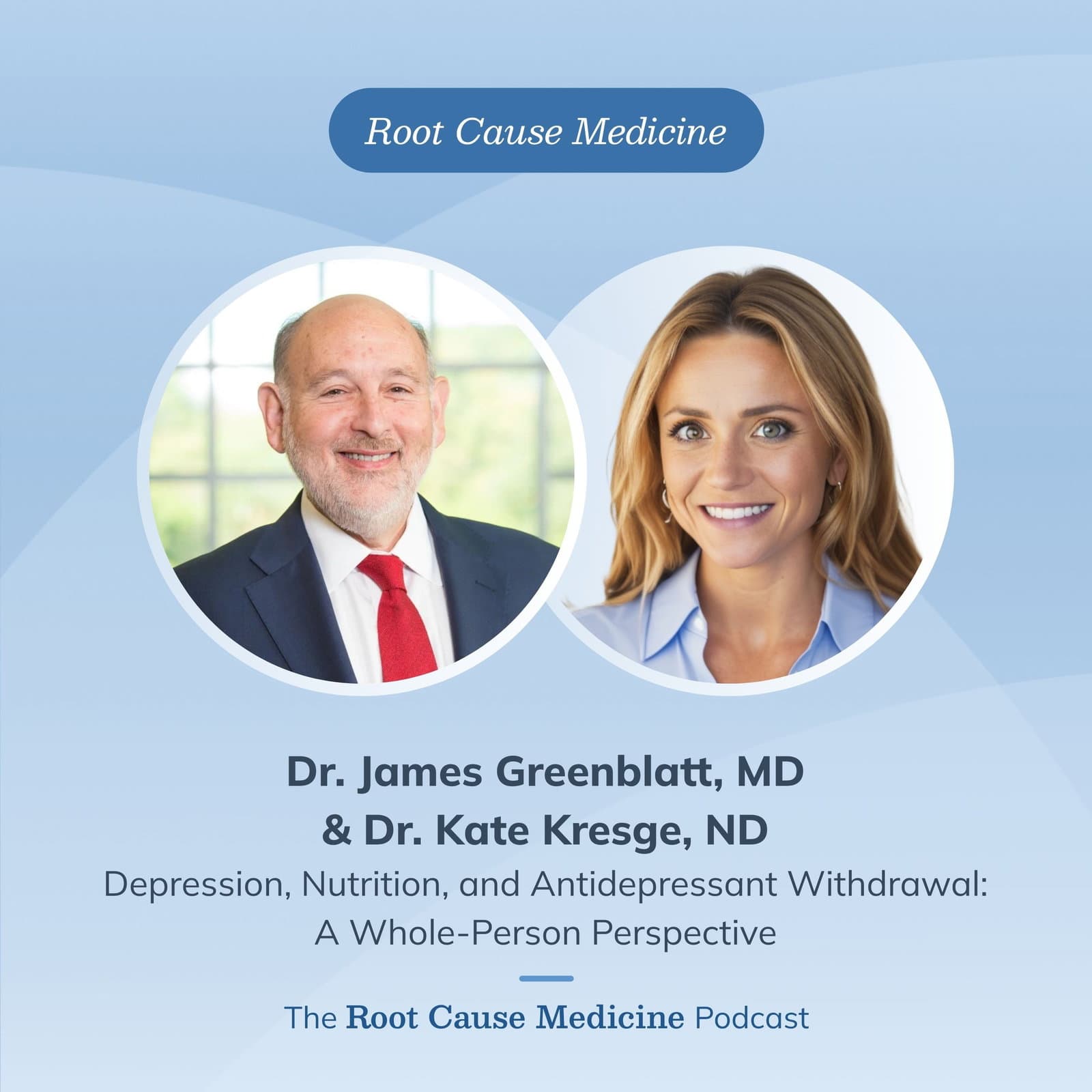
Is lithium a missing piece in brain health research? In this episode, Dr. Kate Kresge sits down with integrative psychiatrist Dr. James Greenblatt to explore one of 2025's most talked-about studies. Researchers found that naturally occurring lithium is reduced in the brain early in cognitive decline, and that a low-dose lithium salt prevented and reversed Alzheimer's-like changes in mice. (Aron 2025) Dr. Greenblatt puts those findings in context with decades of research on nutritional lithium, from environmental exposure and mood to impulse control, and shares how he thinks about forms, monitoring, and safety in his own clinical practice.
3 Key Takeaways
- Lithium may be part of normal brain physiology. Of 27 metals measured, lithium was the only one significantly reduced in the brains of people with mild cognitive impairment, and it was further sequestered by amyloid plaques in Alzheimer's disease. (Aron 2025)
- Form appears to matter in mice. Lithium orotate, which binds amyloid less than other salts, prevented pathology and memory loss in Alzheimer's mouse models and aging mice at doses far below psychiatric levels. (Aron 2025) The study's authors are planning human trials. (NIH 2025)
- Monitoring is part of the plan. Dr. Greenblatt discusses tracking thyroid and kidney function over time, along with environmental and dietary lithium exposure. (Gitlin 2016)
Guest: Dr. James Greenblatt, MD, is an integrative psychiatrist and pioneer in nutritional psychiatry with more than 40 years of experience. He is the author of Nutritional Lithium: A Cinderella Story and offers training programs for clinicians on nutritional approaches to mental health and cognitive health.
Clinical FAQ
What did the 2025 study actually show?
Lithium depletion in mice increased amyloid and phospho-tau and accelerated cognitive decline, while low-dose lithium orotate prevented these changes. (Aron 2025) These are animal and postmortem findings, and human trials have not yet been reported.
How is nutritional lithium different from lithium carbonate?
Lithium carbonate is a prescription mood stabilizer used at much higher doses. (Gitlin 2016) Dr. Greenblatt discusses how low-dose nutritional lithium differs in form, dose, and clinical use.
Where does lithium come from naturally?
Drinking water, certain foods, and geographic variation all influence lithium exposure, which Dr. Greenblatt connects to research on mood and behavior. (Memon 2020)
Timestamps
– Introduction and episode overview
– Harvard's research on lithium and cognition
– Lithium in psychiatry and nutrition
– Neuroprotective mechanisms and GSK3 inhibition
– Lithium carbonate vs. lithium orotate
– Lithium sequestration by amyloid plaques
– Neurotransmitter balance and mood
– Safety, dosing, and lab monitoring
– Geography and natural lithium exposure
– Impulsivity and behavioral health
– Clinical case examples
– Prevention potential and future research
– Resources and closing
Ready to elevate your practice? This episode is sponsored by Fullscript, a comprehensive care delivery platform designed to support whole-person, integrative healthcare. Fullscript helps clinicians bring supplement dispensing, lab ordering, and patient education into one centralized workflow. For more practitioner education on supplements, nutrition, and evidence-informed clinical care, visit Fullscript Academy at academy.fullscript.com.
Disclaimer: The views expressed on this podcast are those of the hosts and guests and don’t necessarily reflect those of Fullscript or any affiliated organizations. This podcast is for informational and educational purposes only and is not intended to be medical advice. For your safety, always check with your doctor or healthcare provider before making changes to your health routine.
Recent episodes
- New
 November 12, 20261 hr 6 min
- New
 November 5, 202633 min
 October 29, 202651 min
